
I have been looking into schedules. Even when we read physics, we inquire of each least particle, What then shall I do this morning? How we spend our days is, of course, how we spend our lives. What we do with this hour, and that one, is what we are doing. A schedule defends from chaos and whim. It is a net for catching days. It is a scaffolding on which a worker can stand and labor with both hands at sections of time.
~Annie Dillard, The Writing Life
A
On the first of each month,
a guest writer
shares
how they spend the day.
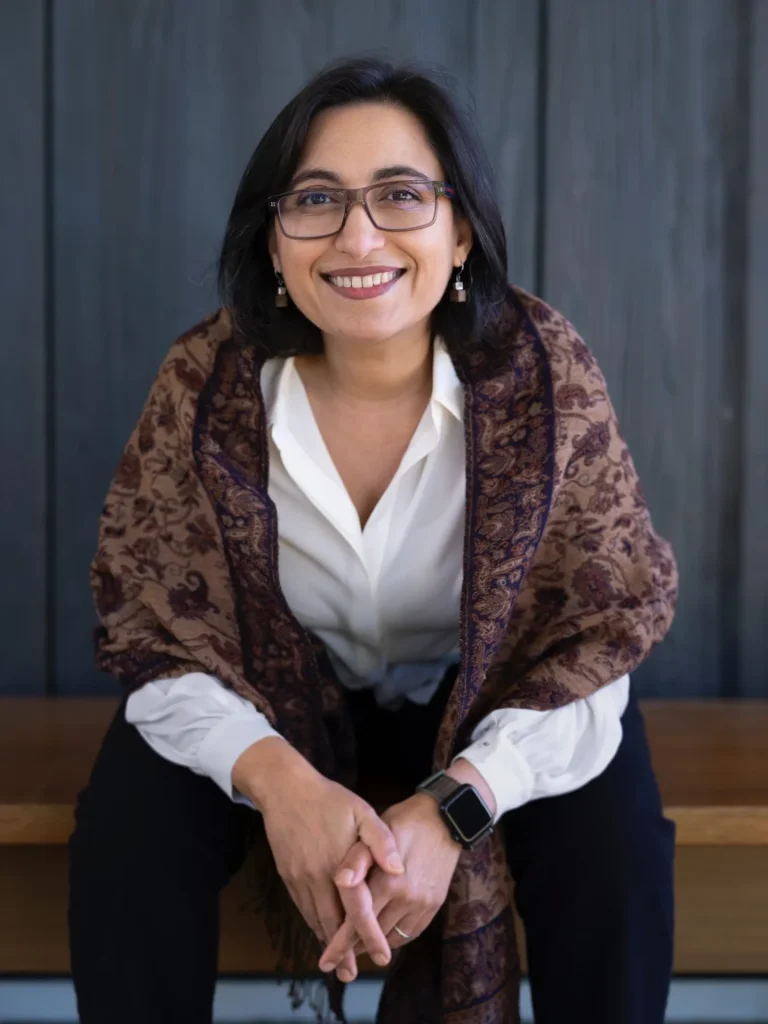
Photo Credit: Jamey Stillings
xA
July 1, 2026: Tayyba Kanwal
X
In Tayyba Kanwal’s Talking with Boys, the stories begin in Houston in 2015 with a girl running away from home and end in Houston in 2020 with a woman buying a home. In between the first and the last of these fifteen linked stories, we also go to Dubai and to Pakistan as well as back in time. This collection was the winner of the 2023 Black Lawrence Press Immigrant Writing Prize.
In the first story, “The Girl Who Ran,” eighteen-year-old Amal is described as a runner with “headphones on, house music throbbing, salt air in her hair.” When she discovers that her father’s threat to send her back to Pakistan to marry her off is more than vague, she takes things into her own hands and marries herself off—to Zeeshan, a friend of her brother’s who lives in the US and whose family has money. While this is a bold move, there’s a conversation between Amal and her new mother-in-law, Zeba, that cracks Amal’s world open. It begins with Zeba asking Amal what it will take for her to “give me my son back.”
For one relief-flooded minute Amal pictured herself entirely unbound, on the road to who-knows-where. But she couldn’t deny the most practical reason she’d needed Zee. For a place to rest. For a home base from which she might wander at will. She admitted to Zeba that Zee had missed some school. “I could help him focus again,” she said. “He’d do anything for me. He loves me.”
“But you don’t love him,” Zeba said quietly. She searched Amal’s face. “Those eyes of yours are always on the horizon.”
Amal thought she should resent Zeba’s words. But, somehow, she felt seen rather than seen through.
You’ll have to read the story yourself to discover if there’s something that would make Amal give Zeba her son back.
Maybe my favorite story in the collection is “Mehr,” which takes place in Pakistan in 1986. Here’s the super visual first sentence: “Mehr perched on the crescent moon at the tip of the minaret of the town mosque.” The narrative voice is light and echoes the feeling of a character who could fly around town. Two weeks earlier, it turns out, her father had told Mehr that not only was it time for her to start wearing a burqa but also that he had saved so he could have one made for her out of a new lighter fabric. “Your Ammi’s was so heavy,” he says. Mehr challenges her father, asking how he will recognize her if she’s wearing a burqa, and he replies, “A father knows his own daughter.” We will see, right?
“Telling Tales,” which takes place in Dubai in 1989, begins with attitude and a gorgeous first paragraph.
Anyway, the scandal of it all was lost on me. The mirror had seen everything, and all of it was true, every tale already known in our hearts. I, like countless others, had come to Dubai on the wings of our relatives’ dreams; and sometimes, to escape the web of nightmares they spun around us. We came with papers but no plan.
Shireen is the one with attitude. She’s the henna girl in a salon. The mirror in question is mounted in the back panel of a clawfoot china cabinet. Shireen watches the mirror and comes to understand it, wondering “how many memories it took to drag the mirror down one millimeter” and “if different memories had different weights.” There’s a beautiful moment in the middle of the story when Shireen thinks of hanging a curtain over the mirror to give it some relief.
Then I thought, would I rather have been blind than seen what my father did to my mother? Instead, I began to wipe the glass front of the cabinet with vinegar and newspaper. If the mirror could see, let it have clarity.
These stories are intricate and detailed, and most have a subplot as interesting as the main storyline, making the reader wonder what if Tayyba had shone her light over there… And more than once we find that in a later story she has moved the light. So much to be discovered in this collection. If you’d like to read more about Talking with Boys, I highly recommend these two conversations at The Rumpus and Necessary Fiction.

 Tayyba is a Pakistani-American writer who grew up in Dubai and came to the US at the age of seventeen but returned to Pakistan every summer for two or three months. She is the Managing Editor at Conjunctions and the Associate Fiction Editor at Cutleaf Journal. Her writing has appeared in Witness, Meridian, Gulf Coast and other journals. She holds an MFA from the University of Houston Creative Writing Program where she was an Inprint C. Glenn Cambor Fellow. Tayyba is also a mathematician and a technologist, holding an MS in Mathematics from the University of Oregon.
Come back on JULY 1st to read how TAYYBA KANWAL spends her days.